Muddling Through All the “News”

In today’s world, it can be hard to decipher what is true and what is not with how available information is nowadays. Passing off stories as news can occur easily since everyone is capable of having a voice with social media.

There are certain sources that can check whether news is real or not. One website that is great at verifying stories on the internet is Snopes. Having resources like Snopes is extremely important in the world we live in today.

An important thing to recall is that official news sources are trustworthy, overall. At times, political candidates can tend to vilify the media that is biased against them. However, in a country that has free press, it is important to upkeep it in order to retain a true democracy.

Source: flickr.com

With the internet, consumers have to be careful about the stories that they read. It can be easy for someone to believe a story if it coincides with one’s beliefs. According to The Atlantic, a false story reaches 1,500 people six times quicker. A common place for fake stories to be shared is on Facebook. This became especially common in the last presidential election.

In my own experience, my older relatives typically fall for these fake stories. I believe it’s easier for younger people to pick apart which stories are true and false since we have been surrounded by the internet all our lives.

However, a Stanford study has proven otherwise. In the study, it was reported that 80% of middle schoolers believed that ‘sponsored content’ was actually real news stories. Another part of the study was showing high schoolers a picture of a mutation in flowers as a result of a nuclear disaster. Many of the students did not ask where the photo came from to verify it.

A need for media literacy is obviously needed for all generations. For people in school, there should be an added component into schools about how to handle information online. By giving children this information, it can move them to start a conversation with their parents and grandparents about what they see on the internet.

Another important skill to teach people is to check multiple sources to verify information that they have received. This can be as simple as typing in the article name into Google and seeing if any similar things come up. One of the easiest way to know if news is real is to see if opposing news sources are reporting the same thing.

Evaluating whether a story is true or not can be hard to do in our fast-paced world, but it is important to slow down and determine the validity of what news we are intaking. We have to break the habit of trusting the first story that aligns with our beliefs. People need to be encouraged to check their sources on websites like Snopes.

If people start to have a better understanding of what they are reading and start a conversation, then hopefully there would be less confusion and conflict when discussing political issues. A large majority of conflict in the world comes from a lack of communication.

The Changing Face of Persuasion

Public relations has changed drastically since the dawn of the Digital Age. Nowadays, PR professionals have to keep up with the rapidly changing environment of technology. Some of the ways PR professionals keep up with the media is through native advertising. An example of this type of advertising would be a sponsored Instagram post. While scrolling through the feed, it looks like any other post, except in the top corner it actually says sponsored.

A sponsored post from my personal Instagram feed

When looking for an example of native advertising, it was not hard to find. I went to my Instagram and it was the second post that showed up on my feed. I typically follow a lot of beauty gurus and Instagram has taken notice that I would probably not think of makeup as an ad.

Going off of native advertising, social media, as a whole, has shaped PR drastically. It is the best way to easily promote a brand or a client. In class we discussed that one of the fastest growing techniques is “buzz” marketing. Going back to previous class discussion, it is reiterated just how important attention economy is in this day and age.

Another concept that PR uses currently is cause-related marketing. This is an integrated marketing technique that has a connection to philanthropy. It may include in-kind promotions or donations to a certain cause. One example of this is TJ Maxx’s campaign where they donate the proceeds from their reusable shopping bags to Save the Children’s programs.

These PR techniques are similar to what I expected the world of public relations would be like. I know that social media plays a huge role in conveying a message about a person or brand and is a great tool for PR professionals. Like the Forbes reading said, the internet is the largest form of communication for people. In addition, the Holmes Report reading stated that 50% of people are turning away from traditional media. Communicating on the internet is extremely important. Also, the use of cause-related marketing is a good tactic for people in public relations to use since it promotes a good image of a brand if they donate to charities.

One of the other pillars of persuasion is advertising. Advertising infiltrates many things we do, but there are ways it can be limited. With the age of the internet, there are ad blockers for computers and if people do not watch cable, then how much advertising they consume could be slim. When it comes to my own personal experience, I do still receive quite a lot of advertising since I like to watch YouTube and Hulu which is full of ads. However, many teens have ways to go around experiencing what they would call “inconveniences.”

I believe that advertising can sneak it’s way into our lives, however. An example of this would be product placement. As the Balance Careers article stated, product placement can be done in a practically seamless way nowadays like what kind of car a character drives on a TV show. The Guardian article continued on the notion of product placement and said that companies have moved to paying for story lines about their product. An example we saw in class was Modern Family having an episode based around one of the characters wanting the new Ipad for his birthday.

In all, public relations and advertising shape the way media persuades us on a day to day basis. It is important to take notice where our attention is being paid to and realize what tactics were used to get it to go there.

Saving the World of Print News

One of the main dilemmas of journalism today is what the future of print news is. The popularity of it is declining, and people rarely get a printed newspaper nowadays. A 2017 study found that newspaper consumption went down 10% from the previous year for Sunday papers.

From class discussion, it was obvious that the new generation, especially, is not interested in buying a newspaper subscription. Most news can be accessed for free on the internet, so many young adults do not see a need for a physical copy.

However, a dilemma that was raised in John Oliver’s broadcast from 2016 was that broadcast news relies heavily on print forms of news to get their information. Although they provide credit to the newspaper that they take information from, there is no monetary compensation to the newspaper for its work. Broadcast news gets to use the information for free, and as a result, the print news suffers.

With the lack of willingness of people to pay for a newspaper subscription, the staff of newspapers has suffered. Between 2008 and 2017, it was reported that newsroom employment dropped 23%. With this lack of staff, it can be difficult for people to report on the stories that truly matter. From Oliver’s video, people tend to gravitate to stories they want to hear rather than need to hear.

A movie that Nicco Mele’s business model podcast referenced, as well as the Oliver video, was Spotlight. This movie, from 2015, covered the reporting by The Boston Globe on allegations against John Geoghan, who was accused of molesting over 80 boys.

Source: flickr.com

This movie shows the importance of journalism and a specific type of it, which is watchdog reporting. John Oliver’s video did a parody video of what journalism would be like if it only focused on cutesy stories rather than the real issues. It showed the very real issue of people leaving the news organization, and people focusing on irrelevant stories like a raccoon that looked like a cat.

Journalism is getting harder for the public to trust nowadays with the rhetoric of “fake news.” There are definitely sources out there that do not qualify as true journalism, but many trustworthy news organizations still exist.

America’s press started off with print news and it should stay that way. Without a free press, the democracy of the country is in serious peril. Some newspapers, like The Washington Post, have tried to make their subscriptions as affordable as possible for their consumers. However, it is difficult for newspapers to make their subscriptions too cheap since that is the way they earn a lot of their money. Before, many newspapers earned their money from the ads they sold to go into it. Now, many people choose to advertise online since it is usually cheaper and more likely to reach a wider audience.

Our class discussed some ways that the print news industry could be saved. Although it would not be easy, print news could start charging broadcast news companies to pay for the information that they take from the newspaper. This would be a good way to teach the broadcast news companies about their dependency on print news and how there is a price to keep it in business.

Overall, saving the print news industry will not happen overnight, but it is extremely important if we want to keep real people writing our stories instead of robots like “What is the Future of Journalism in the Digital World,” by Forbes suggests. Hopefully, the need for print news will become apparent and seen as the backbone to withholding the country’s democracy.

How We Are Today

For this blog, I watched the PBS Frontline Film, The Facebook Dilemma. This film focused on how our generation is obsessed with the number of likes they receive across social media platforms.

Something that stood out to me in the documentary was when they said that our generation treats likes as validation. That is definitely true and I have seen many examples of it with my own friends. How many followers you have and the likes you get have become almost a status symbol among people my age.

In the video, there was a clip where a group of teenagers was all discussing what profile picture one of the teens should post and talking about how many likes they generate. This seemed like a bit of an exaggeration to me, but it is not too far fetched from reality. I have on multiple occasions sought approval from several friends before posting something on social media.

Source: flickr.com

Something I found really interesting about this video is that it is probably not that old, but it already seems so dated. There was a segment where they talked about Youtubers, and how many subscribers they had. They made a big deal about channels with one million subscribers, but nowadays that’s not that many subscribers. A million is like the starting point. The channels that I watch have over ten million subscribers and are continually growing.

One of the Youtubers they mentioned was Shane Dawson. They stated that he had about three million at the time, but now he is up to almost 21 million subscribers. He is creating mega series that generate anywhere from 15 to 25 million views on each video. A large part of the reason he gets so many views is from the people he films with, which are also extremely famous on YouTube. He also creates high-quality videos and works with a videographer and editor, Andrew Siwicki.

This documentary does not fully encapsulate just how big social media is becoming. Many people my age do not watch cable television anymore; they turn to YouTube instead.

With the platforms we have today, it is nearly impossible to live in privacy. Even if you are not posting on social media, you are probably having some sort of your life being put onto the internet. This comes from what you like on social media, what you share, and so on. When you are on social media, you have to be okay with your own privacy being infringed on to a certain extent. Some may find this unsettling, but it is how marketing is done these days. Ad campaigns are based around how many people they can get to click and with that comes some downsides.

Something else that was brought up in the video is just how much the communication between the brand and the consumer has changed. Before, it was more of one-way communication, but now it has turned into a two-way form of communication where the consumers are helping to spread the advertisers’ messages through what they share on social media.

While you may think that social media has totally taken over our private lives or not, you cannot deny the fact that you agreed to what these platforms are doing. Many people do not read the terms and conditions when they create an account. It’s less of an issue of what is fair in our nation’s democracy, and more about encouraging people to be informed with what they are taking part in.

The Electronic Barrier

In a word that is so connected with technology, it can be hard to realize we’re not actually connected as people. Meaningful conversations have been reduced to emojis and feelings have been converted into a set of hashtags. Our world has changed drastically ever since the start of the digital age.

As I stated in my first blog post, I am part of Gen Z. I was born in 1999, so most of my life I have had some sort of technology in, but I am set apart from the current “tablet generation” of kids today.

I got my first phone in the seventh grade, but I was looking at screens far before that. I loved board games, but I could not resist online games as well. The older I get, the more dependent I feel like I am on my phone. Many of my conversations with people occur over text or Snapchat. When I get together with friends, there are times where I run out of things to say and just look down at my screen. Screens have given us an excuse to not be all there.

In class, we listened to a TED talk by Sherry Turkle and an interesting point she made was that we do not know how to be alone. That is definitely true. Not consuming myself with some kind of entertainment at all times seems alien. We are attached to our devices like they are part of our hand. We scroll endlessly on social media apps without thinking of the consequences.

Douglas Rushkoff says in his book, Program or Be Programmed, “We are looking at a society increasingly dependent on machines, yet decreasingly capable of making or even using them effectively.” 

Source: https://www.flickr.com
An accurate representation of what most of us look like nowadays, tangled up in all of our devices.

I believe that the original purpose of technology was to connect us more, but we seem to have gone astray from that path. Now, technology is not pure evil, but it’s important to realize where it is making us less important in our day to day lives.

There are many benefits to talking online with people even though it does not seem like a proper conversation without that face to face contact. A great example of this that has appeared in my life is the app, Whatsapp. This is a messaging app where you can talk to people all over the world. I was first introduced to it when I hosted an exchange student from Argentina. It gives me the opportunity to still talk to her and the people from her exchange group anytime even though we are so far away. It is also a great way for me to practice my Spanish.

I think it is easy for older generations to dismiss people my age as merely obsessed with their phones and not contributing anything to the real world, but sometimes our screens bring us together for the good. I have noticed a large growth in teens and young adults being invested in politics and fighting for causes they care about. I believe this is due to the easily accessible platform of social media to have their voice heard.

How technology is used is not always perfect, but it is essential for us to highlight the parts of it that bring us together rather than tear us apart.

My Time Away From Technology

Today, February 9th, I went for four hours without any technology. I was nervous to do this assignment but was also excited to see if I was capable of going for several hours without looking at a screen. The culture of spending time on our phones is expanding. This was further proven to me when I got several weird looks from my friends when I told them that I would be doing this assignment.

A perfect quote for just how ridiculous our dependency on technology truly is.
Source: https://www.flickr.com/photos/gleonhard/28378462554

I started my challenge at 10 a.m. I thought the earlier I did the challenge in the day, the easier it would be. I turned my phone off, put it in my bedside drawer and tried to forget about it.

It occurred to me, have I ever actually done that before? I feel like I always have my phone on me, so actually putting it in a drawer like it was some trinket was new to me. With the phone out of sight, I started to become really productive. I usually scroll on social media for some time before getting my day started. However, with this challenge, I was forced to get a start on my day much sooner.

One of the things that I was worried about most with not having my phone was that I could not listen to music. For me, I’m listening to music almost constantly. Absolute silence gets on my nerves and I like to have at least some sort of background noise.

While I was getting ready, I started to get annoyed with the silence and started to hum and sing just to fill the void of no sound. It became apparent to me just how much I use music in every part of my life.

Since I had a lot of time to get ready for the day, I took more time with my appearance and tried to really perfect my makeup. This took up several minutes of my time.

After I finished doing my makeup, I decided to clean my makeup brushes, a task I had been ignoring. It felt really good to get things done that I usually put off to go on my phone.

I finished up my routine, including putting on my watch. I usually rarely wear a watch, but I knew I’d be needing one since I could not check my phone for the time. After that, I looked through a magazine for about fifteen minutes or so. I decided to flip through it to get some inspiration for what to cook for dinner tonight. This magazine was dedicated to showing one pan recipes, which is an essential if you’re a college student like me and have to hand wash all your dishes. Unfortunately, most of the recipes served 4-6 people, so I gave up and decided to do something else with my time.

I knew it’d be a lot easier to give in to my desire to use technology if I stayed in my apartment, so I went to Target and Hobby Lobby. These are a couple stores that I can usually spend hours in and felt like they’d aid in the process of going without technology. When I got into the car, I even turned the radio off since I assumed this would also constitute as technology. If you know me, you know silent car rides are on my list of what annoys me most. Like I said before, I like my background noise.

The last hour seemed to be the hardest since I was starting to feel impatient with the process. However, my four hours went by much quicker than I had anticipated and bringing technology back into my life was not as satisfactory as I thought it would be. It gives me faith that I can start to do challenges like this more often.

My Digital Invitation

Nowadays, if you did not post that you did something on social media, did it really happen? Instead of enjoying the moment, people spend countless tries to perfect the exact photo to post to describe their night. Instead of having meaningful conversations with friends, the conversation is often rather, “Hey, what should I caption this?”

Now some people are aware of this strenuous obligation we all feel like we have, yet others blindly attend to this integral part of our society. Social media has become a highlight reel of our lives. People’s accounts are a digital invitation to say, “Hey, look how well I’m doing. Are you?”

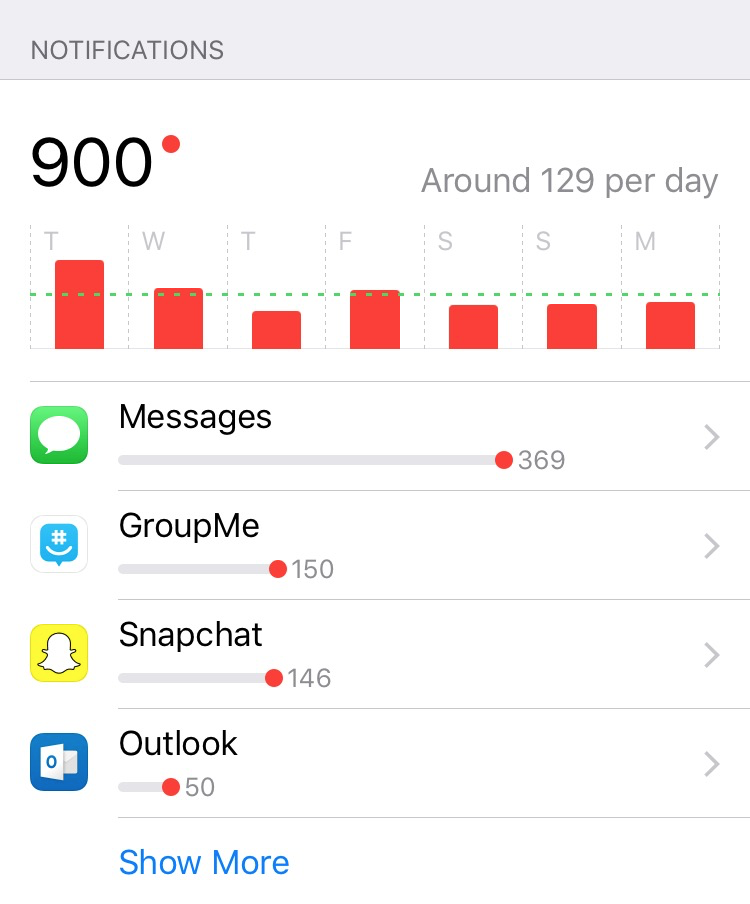
The constant buzzing and notifications we receive from our phones are frankly exhausting. Apple has come out with an application called Screen Time, which tracks how many hours a day you use your phone and the number of notifications you receive. When I looked at how many notifications I receive in a day, I thought, “No wonder why I feel anxious.”

A screenshot of a breakdown of the notifications I receive on a weekly basis

On average, I receive 900 notifications a week. That’s enough to make someone’s head spin. There is a constant string of text messages, emails, and Snapchats. No wonder why we barely have attention spans these days, we’re constantly switching from app to app to see where the latest action is. In class, we watched a TED talk where it was discussed the ridiculousness of Snapchat streaks. Teens are just sending pictures of nonsense back and forth to keep a flame going by the person’s name. We are not having real conversations anymore.

Many people are more concerned with how many followers they have rather than if they are making a positive impact with what they are posting. What truly matters is getting lost amongst all the hashtags blurring our vision.

The Digital Age has changed practically everything we do. Dating these days is completely different from even when our parents were dating. No longer are the days of meeting someone naturally and getting to know them, but instead, the swiping for love fad. In class we watched a TED talk about how a woman hacked online dating to meet her “perfect man.” The lengths she went to sift through all of the men on the dating website she joined sounded insane. What’s she going to tell her kids when they ask how she and dad met? “Well, I created a point system and went through lots of men.” It’s absurd!

Although there are several things that bother me about how the digital world is, I cannot seem to escape it. I have been conditioned to care about what everyone is doing on their weekends and hoping my post compares to theirs. Little things can make a difference, however. For example, when I hang out with my friends, I try to stay off my phone and be engaged in the conversation. It’s actually a relief when I check my Screen Time app, and my hours of usage have gone down from previous days. There are also games you can play to keep you off your phone. I saw a post where a group of friends stacked all of their phones on the table at a restaurant and the first one to pick up their phone, had to pay the bill. It may sound extreme, but it’s worth it to break the dependency we have on these glowing little boxes we call “phones.”

Brooke’s Take on JRM 215

This is me in my favorite spot in Kansas City, the Country Club Plaza!

About Me

Hello! My name is Brooke Memoly and I am a sophomore here at Creighton University. I am studying Journalism on the public relations track and Spanish. Some of my interests include theatre and music. My favorite bands or artists are Queen, Enrique Iglesias, and Rex Orange County.

How I Got into Media

I am taking JRM 215 because it is a requirement for the JMC core here at Creighton. My experience with media has been pretty exclusive to social media. I believe it allows everyday people to put their message out into the world. Sometimes that is not always a good thing, but I believe that social media was originally created in hopes that it would be used for the good.

When it comes to where I get my news and information from, I usually turn to social media first and back up the information I received with online news organizations. Typically, I pay most attention to the news organizations in Kansas City, Missouri. I am like what most people expect the Gen Z generation to be like, and I am using some sort of screen almost constantly. I am definitely way too into my phone and if I am not on it, I am most likely on my laptop. It is not the best habit but is, unfortunately, the effect of living in the digital age. I will pick up a newspaper from time to time, but it is hard to beat the convenience of just googling what you want to know.

With the news media, I believe that the most frustrating part about it is how some organizations use fear. I believe that news should be used to inform us, not scare us. This fear is caused by exaggerating certain stories to make certain groups seem like villains. Rolling Stone covered how Fox News does this very thing.

When it comes to what news media and journalists do well, I believe that they make a point to correct their mistakes and to try to provide updates as they go. Doing this is not always easy, but is an essential skill when it comes to accurate storytelling. Most news organizations want to be the first to report something. With this, there can come many mistakes in what information they give to the public. That is why it is admirable for news organizations and journalists to acknowledge when they have made a mistake and to keep their listeners engaged.

As part of my journalism education, I have had to work with many different mediums. Part of that included learning how to code. I took a class called Computers and Scientific thinking last semester and learned some basics about HTML and how to create some interactive web pages with JavaScript.

This is a screenshot of one of the web pages I made that simulates a Magic 8-ball and gives out an answer when a question is entered into the box.

Learning how to build a website is very useful nowadays with how reliant we are on the internet to obtain news. Our world is constantly surrounded by different media inputs. Unfortunately, this is overwhelming and it can be hard to know who to trust with so much information circulating. The benefit of how connected media is today is that it provides several different viewpoints. It is also helpful, in that, I can look up news from around the world and stay fully informed while taking in multiple viewpoints. The main way the world stays connected is through social media. The International Association of Business Communicators adapted these trends into an article showing how connected the world can be.

Whether we like it or not, we all have an impact on the media. Whether we listen to the news, post on social media, or talk about what’s going on with our friends, the media impacts us more than we can imagine. Hopefully, this class will give me insight into just how impacted my life is from it.